#1 Fashion Inventory Planning Software
Tag1
Tag1

Best E-commerce Inventory Management Software in 2026

By: Dhruv Srivastava
Updated :
July 1, 2026
8 min read

Best Ecommerce Inventory Management Software in 2026

Here is a hard truth: 43% of online shoppers say they will not return to a brand after a stockout experience. Yet most ecommerce brands still manage inventory through spreadsheets, gut instinct, or disconnected tools that cannot keep up with real-time demand.

This guide covers the best ecommerce inventory management software in 2026, alongside the strategies, formulas, and KPIs that the fastest-growing D2C and multi-channel brands actually use. Whether you are just moving off spreadsheets or scaling to multi-warehouse operations, you will find the right fit here.
What Is ecommerce Inventory Management?

E-commerce inventory management is the end-to-end process of tracking, controlling, and optimizing product stock across all your online sales channels in real time. It covers everything from the moment a product enters your warehouse to when it ships to the customer, including returns.

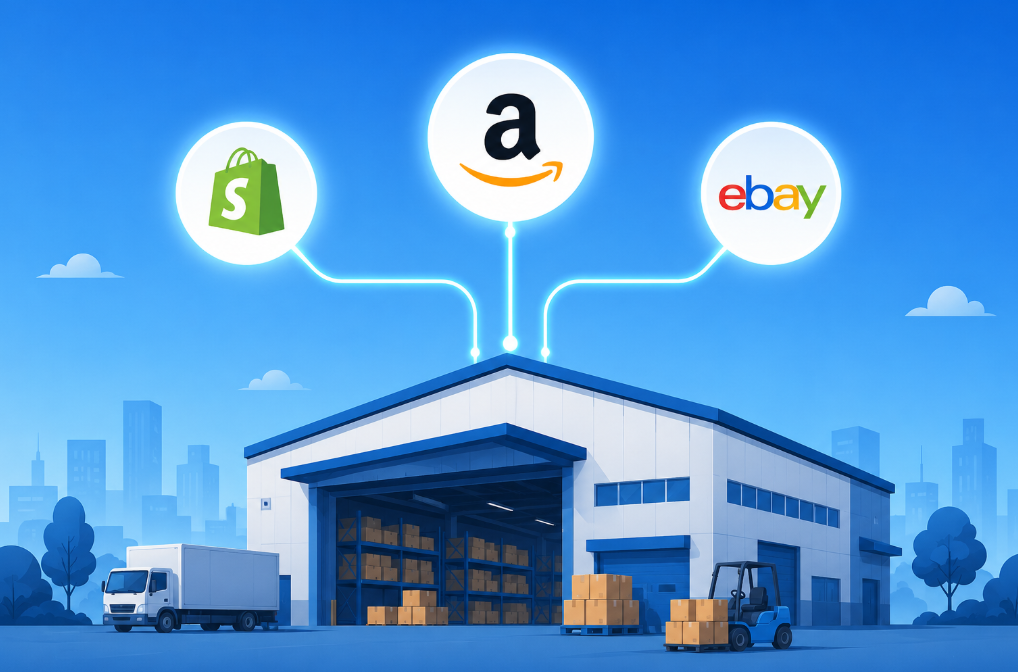
Unlike traditional retail inventory, ecommerce operates across multiple simultaneous channels. A single sale on Shopify must instantly reflect on Amazon, eBay, your physical POS, and any 3PL partner. Without a centralized system, you are always one flash sale away from an overselling disaster.

How It Differs from Traditional Inventory Management

  • Speed of turnover: Promotions, influencer drops, and viral moments can sell out inventory in hours. Traditional retail rarely faces this.
  • Multi-channel sync: Stock must update across Shopify, Amazon, eBay, Instagram Shopping, offline stores, and 3PLs simultaneously.
  • Real-time accuracy: Physical stores tolerate end-of-day counts. ecommerce requires sub-second inventory updates to prevent double-selling.
  • Returns complexity: ecommerce return rates average 20-30%, versus 8-10% in physical retail. Each return must be triaged, restocked, or written off.
  • Example: A fashion brand selling through Shopify and Amazon FBA with two warehouses in Mumbai and Delhi. A sale on Shopify must instantly deduct from the nearest warehouse, update Amazon inventory, and trigger a reorder if stock falls below the reorder point. All of this happens automatically with the right system.

Why Inventory Management Directly Impacts Revenue

This is not just operational hygiene. Every inventory decision has a direct revenue consequence:

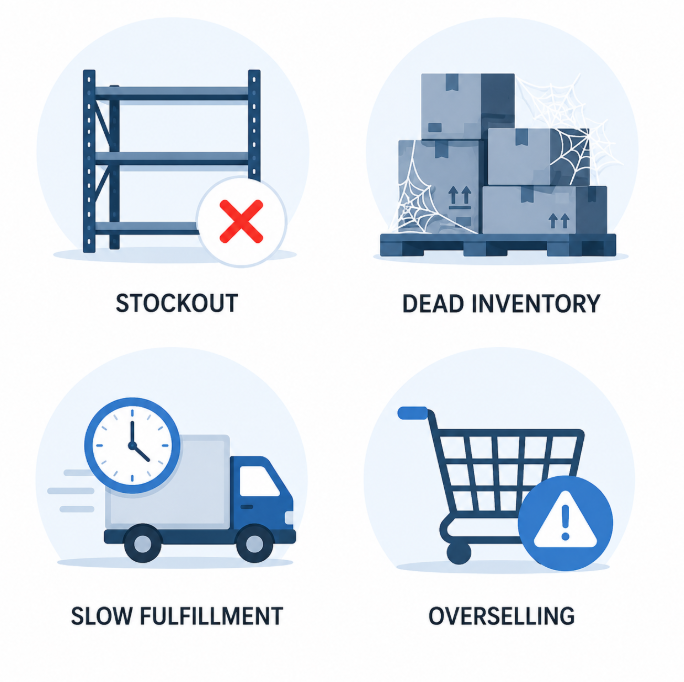
Stockouts cost more than you think.

When a product goes out of stock on Amazon, you lose the sale AND your ranking drops. Amazon's algorithm deprioritizes listings with poor availability. Recovering that ranking can take weeks.

Dead inventory kills cash flow.

Inventory that does not move ties up working capital at an average carrying cost of 20-30% of its value annually. For a brand holding INR 50 lakh in dead stock, that is INR 10-15 lakh per year in holding costs alone.

Fulfillment speed determines repeat purchase rate.

Research shows that 69% of customers are significantly less likely to shop with a brand again after a late delivery. The right inventory positioning across warehouses directly reduces shipping time.

Overselling destroys brand trust faster than any bad review.

A customer who checks out successfully and then gets an order cancellation due to stock error is extremely unlikely to return. This is the most preventable revenue leak in ecommerce.
Top ecommerce Inventory Management Software (2026 Comparison)

Use this table to quickly identify which tools match your business size, channel mix, and budget:

Software Best For Forecasting Multi-Warehouse Pricing Integrations
EasyReplenish D2C & SMB Fashion Yes (AI) Yes Custom Shopify, Amazon
Cin7 Enterprise Brands Advanced Yes $$$ 700+ Apps
NetSuite Large Enterprise Advanced Yes $$$$ ERP-native
Skubana (Extensiv) Multi-Channel Scale Yes Yes $$$ Amazon, eBay, Walmart
Zoho Inventory Small Business Basic Limited $ Shopify, Zoho CRM
TradeGecko / QB Commerce QuickBooks Users Basic Limited $$ QuickBooks Online

Note: $ = under $50/month, $$ = $50-200/month, $$$ = $200-500/month, $$$$ = enterprise pricing. EasyReplenish pricing is custom based on SKU count and warehouse complexity.

Deep Dive: Each Software Reviewed

1. EasyReplenish - Best for D2C and SMB Fashion Brands

EasyReplenish is purpose-built for fashion and apparel brands selling on Shopify and Amazon. It solves the specific complexity of fashion inventory: size-color-style variants, seasonal demand curves, and multi-warehouse distribution across India and globally.

Key Features:

  • AI-powered demand forecasting calibrated for fashion seasonality (not generic retail algorithms)
  • Automated replenishment with smart reorder triggers
  • Multi-location inventory: mother warehouse to child warehouse distribution
  • Vendor PO management with GRN reconciliation
  • Bestseller availability alerts and dead stock identification
  • Native Shopify and Amazon integration

Pros:

  • Extremely fast implementation (days, not months)
  • Designed for fashion's variant complexity out of the box
  • Affordable for SMBs, scales with growth
  • Inventory intelligence dashboard with actionable alerts

Cons:

  • No native manufacturing or deep ERP modules
  • Best fit for Shopify-primary brands; broader ERP integrations are expanding

Best For: D2C fashion, apparel, footwear, and accessories brands managing 500-50,000+ SKUs across Shopify and Amazon.

Pricing: Custom (book a demo at easyreplenish.com)

2. Cin7 - Best for Enterprise and Multi-Warehouse Operations

Cin7 is a full-stack inventory and supply chain management platform built for established brands with complex logistics. With 700+ integrations, built-in EDI, POS, and B2B order management, it handles the entire supply chain in one system.

Key Features:

  • Multi-warehouse inventory with real-time visibility
  • Built-in EDI for large retailer integrations
  • B2B portal for wholesale order management
  • Manufacturing and production workflows
  • Advanced reporting and demand planning

Pros:

  • Handles extreme complexity: multiple warehouses, channels, and business models
  • 700+ native integrations
  • Robust reporting and analytics

Cons:

  • Steep learning curve and implementation timeline
  • Premium pricing that can be excessive for smaller brands
  • Feels over-engineered for brands under $5M revenue

Best For: Established brands with multi-warehouse, B2B + D2C operations and $5M+ revenue.

3. NetSuite - Best for Large Enterprise with ERP Needs

NetSuite is an ERP platform, not purely an inventory tool. For large enterprises that need financials, HR, manufacturing, and inventory in one system, NetSuite is the industry standard. However, it is serious overkill for most ecommerce brands.

Skubana (now Extensiv) - Best for High-Volume Multi-Channel Sellers

Extensiv (formerly Skubana) is built for brands selling high volumes across Amazon, Shopify, eBay, and Walmart simultaneously. It excels at automated order routing to the optimal fulfillment center.

Key Features:

  • Automated order routing to nearest or cheapest fulfillment center
  • Deep 3PL integrations
  • Advanced demand forecasting
  • Multi-channel listing management

Best For: High-volume ($1M+) brands managing 3+ sales channels and multiple warehouses or 3PLs.

4. Zoho Inventory - Best Budget Option for Startups

Zoho Inventory is the most accessible starting point for micro-brands and startups moving off spreadsheets. It covers the basics well and integrates tightly with the broader Zoho ecosystem.

TradeGecko / QuickBooks Commerce - Best for QuickBooks Users

For brands already using QuickBooks for accounting, QuickBooks Commerce offers tight financial-inventory integration. Product development has slowed significantly since Intuit's acquisition, but it remains a strong choice for the QuickBooks ecosystem.

Best For: SMEs already on QuickBooks who want inventory without a separate system.

How to Choose the Right Software for Your Business Size

Startups and Micro-Sellers (Under 500 SKUs)

Your biggest enemy is overspending on tech before you have validated your inventory model.

  • Recommended: Zoho Inventory (free plan) or EasyReplenish for fashion brands
  • Prioritize: easy Shopify integration, basic multi-channel sync, low cost
  • Avoid: enterprise ERPs, complex implementations

Growing D2C Brands (500-10,000 SKUs, 1-3 Warehouses)

You need automation, forecasting, and multi-channel sync. This is where manual processes break.

  • Recommended: EasyReplenish (fashion), Skubana/Extensiv (general multi-channel)
  • Prioritize: demand forecasting, automated reordering, multi-warehouse visibility
  • Avoid: tools with no forecasting, or generic ERPs that do not understand ecommerce velocity

Established Brands and Enterprise (10,000+ SKUs, 3+ Warehouses)

You need a system that can handle EDI, B2B wholesale, complex manufacturing, and global compliance.

  • Recommended: Cin7, NetSuite ERP
  • Prioritize: EDI support, B2B order management, deep integration ecosystem, compliance
  • Avoid: SMB tools that will cap out on your volume

E-commerce Inventory Management Strategies That Work

Strategy 1: Centralize All Channels to One Inventory Source of Truth

Separate stock pools for Shopify, Amazon, and offline stores is the single most common cause of overselling. Every sales channel must pull from one master inventory record, updated in real time.

How to implement: Use a centralized inventory platform as the hub. All sales channels write to and read from it. No manual reconciliations.

Strategy 2: Use ABC Analysis to Prioritize Stock Investment

Not all SKUs deserve equal attention. ABC classification allocates your resources where they matter most:

  • A Items (top 20% of SKUs, 80% of revenue): Keep highest safety stock levels, tightest reorder triggers, priority supplier relationships
  • B Items (30% of SKUs, 15% of revenue): Standard safety stock, automated reordering
  • C Items (50% of SKUs, 5% of revenue): Minimal safety stock, review for discontinuation if turnover is poor

This alone can reduce your overall inventory investment by 15-25% while improving availability on your bestsellers.

Strategy 3: Demand Forecasting - Not Gut Instinct

The two most expensive inventory words are 'I think.' Demand forecasting replaces guesswork with data. At minimum, your forecast should incorporate:

  • Historical sales velocity per SKU
  • Seasonality adjustments (Diwali, Black Friday, summer peaks)
  • Supplier lead times and variability
  • Marketing calendar: planned promotions that spike demand
  • Growth trend: your sales this month vs. same month last year

Brands using AI-driven demand forecasting report 30-40% fewer stockouts and 20-25% reduction in excess inventory compared to manual forecasting.

Strategy 4: Optimize Safety Stock - Not a Flat Buffer

Many brands set a flat safety stock (e.g., 100 units for every SKU). This is wrong. Safety stock should be calculated per SKU based on:

  • Demand variability: how much does daily sales fluctuate?
  • Lead time variability: how reliable is your supplier?
  • Service level target: what stockout rate can you tolerate?

Safety Stock Formula: (Maximum Daily Sales x Maximum Lead Time) - (Average Daily Sales x Average Lead Time)

A bestselling SKU with high demand variability might need 3-4 weeks of safety stock. A slow-mover might need only 3-5 days.

Strategy 5: Define Reorder Points Per SKU

Reorder Point Formula: (Average Daily Sales x Lead Time in Days) + Safety Stock

When inventory hits the reorder point, a purchase order is automatically triggered. This prevents the panic reordering that creates both stockouts (order too late) and overstock (order too much).

Strategy 6: Build Returns Into Your Inventory Model

ecommerce return rates average 20-30% for fashion. Returns are not just a logistics problem, they are an inventory event. Your system should:

  • Classify returns automatically: resellable, refurbishable, write-off
  • Return resellable units to available stock within 24-48 hours
  • Flag refurbishable stock separately with an expected restock date
  • Write off damaged goods immediately to prevent phantom stock

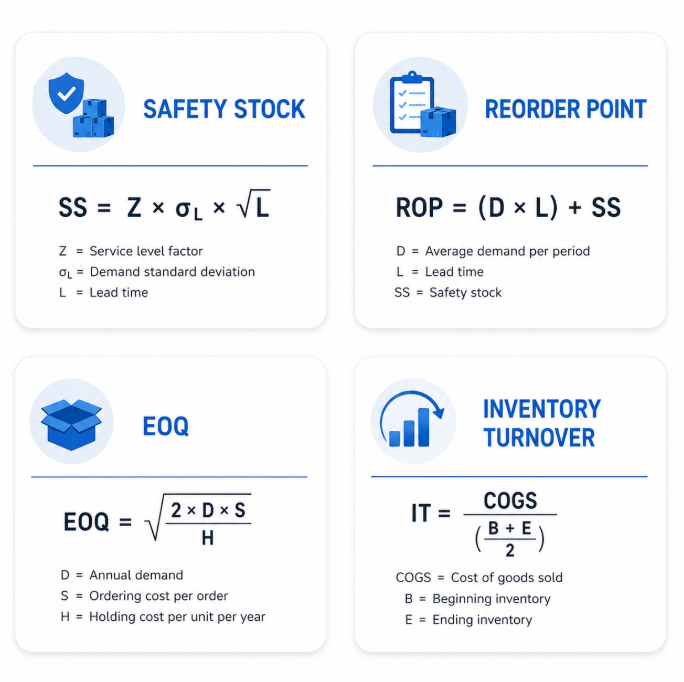
Key Inventory Formulas Every ecommerce Brand Should Know

Safety Stock

Formula: (Max Daily Sales x Max Lead Time) - (Avg Daily Sales x Avg Lead Time)

Example: Max daily sales = 50 units. Max lead time = 14 days. Avg daily sales = 30 units. Avg lead time = 10 days. Safety Stock = (50 x 14) - (30 x 10) = 700 - 300 = 400 units.

Reorder Point

Formula: (Avg Daily Sales x Lead Time in Days) + Safety Stock

Example: Avg daily sales = 30. Lead time = 10 days. Safety stock = 400. Reorder Point = (30 x 10) + 400 = 700 units.

Economic Order Quantity (EOQ)

Formula: EOQ = Square Root of (2 x Annual Demand x Order Cost / Holding Cost Per Unit)

EOQ gives you the mathematically optimal order quantity that balances order costs (admin, freight) against holding costs (storage, insurance, obsolescence).

Inventory Turnover Ratio

Formula: Total COGS / Average Inventory Value

A ratio of 4-6 is healthy for most ecommerce categories. Fashion often targets 6-12 given seasonal velocity. Below 3 suggests you are overstocked.
Inventory KPIs to Track (With Benchmarks)

If you are not tracking these, you are flying blind:

KPI Formula Benchmark / Target
Inventory Turnover Ratio Total COGS / Average Inventory Higher = selling faster, fewer holding costs
Days in Inventory (DII) 365 / Inventory Turnover Lower = fresher stock, less capital tied up
Stockout Rate Stockouts / Total SKUs × 100 Target <2% to protect revenue
Order Fill Rate Orders Fully Shipped / Total Orders × 100 Target >98% for customer satisfaction
Carrying Cost % Holding Costs / Avg Inventory Value × 100 Typically 20–30% of inventory value
Safety Stock Level (Max Daily Sales × Max Lead Time) − (Avg Daily Sales × Avg Lead Time) Buffer to prevent stockouts

Common Inventory Mistakes (And How to Avoid Them)

  1. Relying on spreadsheets beyond 300 SKUs — Manual tracking cannot keep up with real-time multi-channel sales. Errors compound fast.
  2. Setting flat safety stock for all SKUs — A one-size buffer creates both stockouts on bestsellers and overstock on slow movers. Calculate per SKU.
  3. Ignoring supplier lead time variability — If your supplier sometimes delivers in 7 days and sometimes 21, your safety stock must account for the worst case, not the average.
  4. Not triaging returns in real time — Returned stock sitting in a 'pending' state for days creates phantom inventory that leads to overselling.
  5. Only reordering when stock hits zero — By the time you notice, you have already missed sales. Reorder points must trigger well before empty.
  6. Over-automating without human review — Automated systems can amplify bad data. Review your forecast inputs quarterly and audit anomalous purchase orders.
  7. No dead stock process — Every brand accumulates slow movers. Without a systematic liquidation process (discounts, bundles, clearance), dead stock compounds.

How to Implement an ecommerce Inventory System: Step-by-Step

  1. Audit your current state — List every stockout, oversell, and fulfillment delay from the past 90 days. These are your implementation priorities.
  2. Define your requirements — How many SKUs? How many warehouses? Which sales channels? What integrations do you need? Do you need forecasting or just tracking?
  3. Select software matched to your stage — Use Section 5 of this guide. Do not buy enterprise software for a 500 SKU operation.
  4. Migrate and clean your data — Bad data in, bad decisions out. Before go-live, audit your SKU master, clean up duplicate listings, and verify opening stock counts.
  5. Integrate all sales channels — Connect every platform before you go live. Running even one channel manually defeats the purpose.
  6. Set reorder points and safety stock per SKU — Use the formulas in Section 7. Start with your top 20% of SKUs (A items) and expand from there.
  7. Train your team with SOPs — Create written procedures for: receiving stock, processing returns, investigating inventory discrepancies, and handling urgent reorders.
  8. Review and optimize monthly — Run a monthly inventory health check: stockout rate, turnover by category, carrying cost, and dead stock volume.

Conclusion

Managing inventory in ecommerce is not just operational hygiene. It is a direct revenue lever. Every stockout is lost revenue and damaged trust. Every rupee in dead inventory is working capital that should be funding growth.

The brands that scale profitably are not necessarily the ones with the biggest marketing budgets. They are the ones who know their reorder points, run lean on C items, never miss a bestseller replenishment, and make every square foot of warehouse earn its keep.

Whether you are a 500 SKU fashion brand ready to move off spreadsheets, or a multi-warehouse operation looking to centralize operations, the right tool exists for your stage. Start with EasyReplenish if you are in fashion and on Shopify. Start with Zoho Inventory if you are testing the waters on a tight budget. Scale to Cin7 or NetSuite when enterprise complexity demands it.

The worst inventory decision is no decision. Every month on a spreadsheet is revenue left on the table.

Scaling your Fashion
E-Commerce on Shopify?

Inventory analytics powered with
smarter forecasts

Start for Free →
No credit/debit card required • Cancel anytime
Inventory trends alerts

FAQs

1. What is e-commerce inventory management?
2. Which inventory management software is best for Shopify brands?
3. How do I reduce stockouts in e-commerce?
4. What is the difference between safety stock and reorder point?
5. How does inventory management software handle product bundles and variants?
6. What are typical inventory carrying costs?
7. When should I move from spreadsheets to inventory software?