
Types of Inventory: Definitions, Examples & Management Strategies


Inventory management has evolved from static spreadsheets and server-based systems to dynamic, cloud-driven platforms that deliver real-time visibility and control. As supply chains grow more complex and multi-channel selling becomes the norm, traditional systems struggle to keep pace.
That’s where cloud-based inventory management systems come in — offering centralized data, remote accessibility, and seamless integration across warehouses, sales channels, and suppliers. Unlike legacy setups, cloud inventory management isn’t just about tracking stock; it’s about creating a connected, intelligent ecosystem where inventory decisions happen in real time.
For businesses managing multiple SKUs, channels, or fulfillment points, moving inventory operations to the cloud is no longer optional — it’s the foundation for agility, cost efficiency, and scalability.
A cloud-based inventory management system stores and manages stock data online instead of relying on local servers or manual spreadsheets. It provides real-time visibility into stock levels, orders, and fulfillment across multiple locations or sales channels.
Unlike on-premise software, cloud inventory management runs entirely through the internet — meaning automatic updates, remote access, and seamless integrations with eCommerce, ERP, or accounting tools. This eliminates downtime, manual syncing, and IT overhead.
For example, a retail brand selling on Shopify and Amazon can use a cloud inventory management system to automatically sync stock across all channels whenever a sale occurs — preventing overselling and ensuring accurate, real-time visibility across the business.
Avoid Stockouts surplus with —
Real-Time alerts & smarter forecasts.

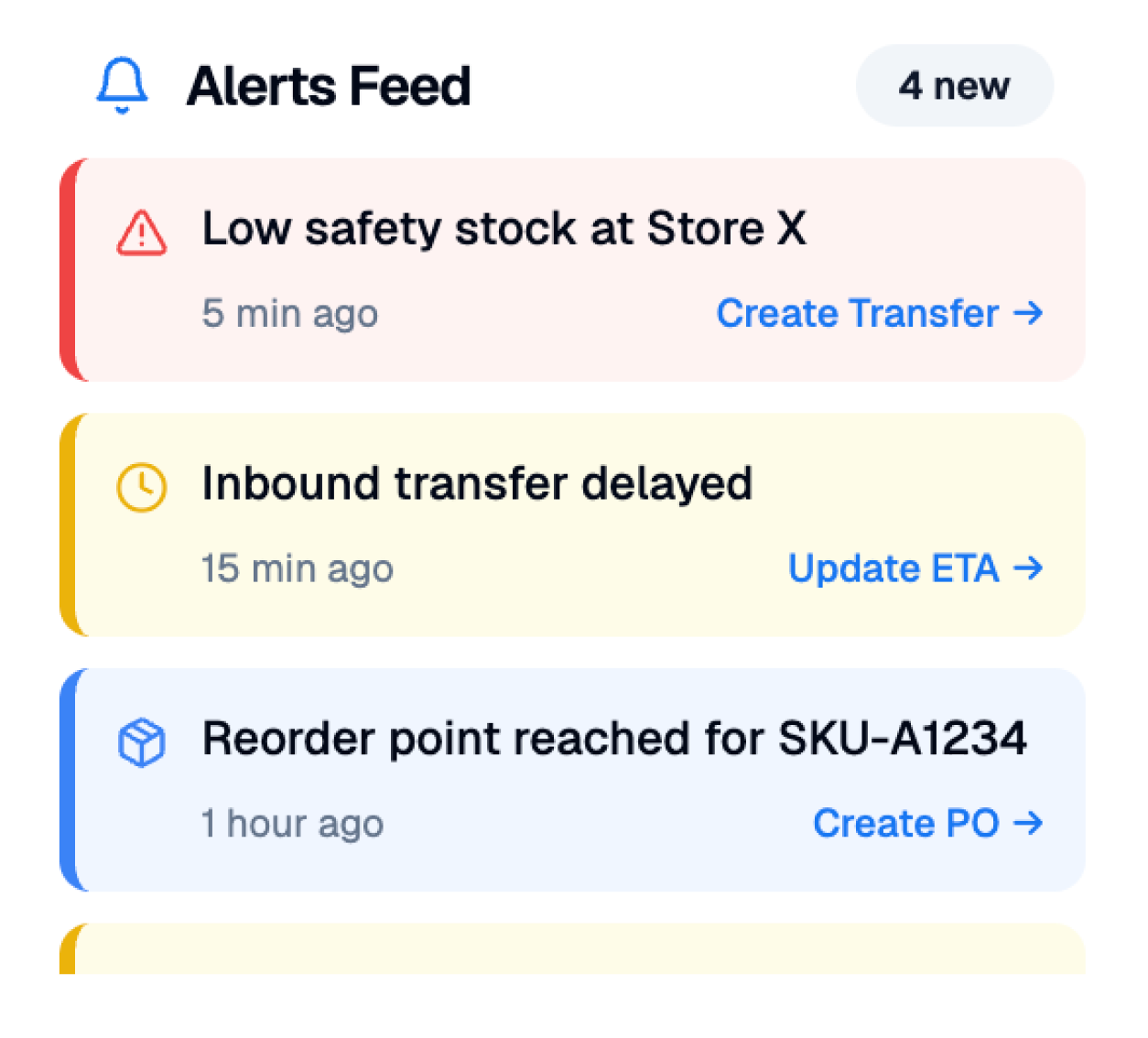
A cloud-based inventory management system is not just an online version of traditional stock software — it’s a continuously connected ecosystem that synchronizes data, automates decisions, and scales across multiple business functions in real time.
All inventory-related data — from SKUs and barcodes to purchase orders and fulfillment logs — is stored in a centralized cloud database rather than isolated local servers.
This architecture enables multi-location and multi-channel synchronization with zero manual intervention.
Example: A footwear brand using a cloud-based system like Cin7 or NetSuite can track 15,000 SKUs across 12 warehouses and 5 online marketplaces, all from a single dashboard, without needing on-site servers or IT maintenance.
Such systems typically use real-time APIs to fetch and push data across channels. According to Gartner, businesses using centralized cloud systems reduce stock discrepancies by up to 35% compared to on-premise systems.
Whenever an event occurs — such as a sale, stock receipt, or return — it triggers an instant data update across all connected platforms.
That means inventory counts, accounting entries, and fulfillment statuses are automatically aligned.
Workflow example:
This event-driven architecture ensures that every system — sales, operations, and finance — reflects the same truth in real time. It’s what allows D2C and B2B brands to scale without increasing operational complexity.
Unlike static systems, cloud inventory platforms use machine learning and historical trend analysis to forecast demand and automate replenishment.
By analyzing sales velocity, lead times, and seasonality, the system can generate recommended order quantities or auto-create purchase orders when stock dips below the calculated reorder point.
For instance, a beauty brand might see that SKU #LIP204 sells 45 units per week on average. If lead time from the supplier is 10 days, the system automatically triggers replenishment when on-hand stock drops below 65 units — ensuring continuity without overstocking.
Advanced platforms even integrate with supplier APIs, allowing two-way sync for PO status, shipment tracking, and backorder alerts.
A cloud-based inventory management system doesn’t work in isolation — it connects with ERP, CRM, logistics, and accounting tools to form a real-time operational network.
This interoperability eliminates silos and redundant data entry.
This interconnected structure ensures transparency across teams — from finance and operations to supply chain and customer service.
All data within a cloud inventory management system is encrypted and backed up automatically across multiple data centers. Unlike local setups, there’s no downtime risk due to hardware failure or software version conflicts.
Cloud vendors typically guarantee 99.9% uptime through distributed server networks and ISO-certified security frameworks.
Additionally, scalability becomes effortless — whether adding new warehouses, SKUs, or sales channels, the system dynamically scales without infrastructure changes or new licenses.
A cloud inventory management system functions as a living, connected layer across your entire supply chain — capturing every transaction, predicting future demand, and enabling truly data-driven operations. It’s what allows modern brands to move from reactive inventory control to proactive optimization — reducing costs, lead times, and manual effort at scale.
Traditional inventory systems were built for static supply chains — a time when sales channels were few, order volumes predictable, and warehouse operations centralized. But in today’s multi-channel, global-first ecosystem, those systems can’t deliver the speed, scalability, and visibility modern operations demand. This shift has accelerated the global transition toward cloud inventory management, a model that combines flexibility, automation, and data intelligence at scale.
Cloud-based systems centralize inventory data from warehouses, stores, and online platforms into one unified dashboard. Every sale, return, or transfer updates in real time, eliminating blind spots.
According to a 2024 Deloitte study, businesses using cloud inventory systems improve inventory accuracy by up to 40% and reduce reconciliation time by 60% compared to on-premise setups.
For example, a fashion retailer managing stock across Shopify, Amazon, and retail stores can instantly view product availability and location-level quantities — ensuring fulfillment decisions are made with real-time accuracy.
With cloud-based architecture, businesses no longer need to invest in servers or maintenance teams. The system scales instantly as new channels, SKUs, or locations are added.
This elasticity is especially valuable for seasonal or fast-growing brands where inventory volumes can fluctuate dramatically.
A D2C skincare brand can onboard a new 3PL or marketplace in days — not weeks — since integrations happen via API, not hardware or local configuration.
This scalability is a key driver of adoption: 72% of mid-market companies now consider cloud-based systems essential for operational flexibility (IDC, 2024).
Cloud inventory management brings analytics and automation into the operational workflow. Instead of relying on periodic reports, teams can track sales velocity, stockouts, turnover, and replenishment triggers live — enabling proactive decisions.
AI-driven forecasting further reduces the guesswork by recommending reorder quantities or identifying SKUs at risk of stockouts.
McKinsey reports that businesses using real-time inventory analytics see 20–25% fewer stockouts and 15% lower working capital tied in inventory.
Because all data resides in the cloud, internal teams (purchasing, operations, finance) and external partners (suppliers, 3PLs) can collaborate in real time.
Purchase orders, shipment tracking, and returns can be managed in one shared environment without endless spreadsheets or email threads.
This connected ecosystem eliminates communication gaps that typically delay replenishment or increase order errors.
Modern cloud platforms use enterprise-grade encryption, multi-location backups, and 99.9% uptime SLAs — giving businesses resilience against data loss or downtime.
Regular automated updates also mean companies stay compliant with evolving data security and tax regulations without IT intervention.
As global supply chains become increasingly digitized, cloud-based systems provide the agility and resilience required to keep operations uninterrupted — even during disruptions like logistics bottlenecks or demand surges.
Avoid Stockouts surplus with —
Real-Time alerts & smarter forecasts.
Choosing between a cloud inventory management system and a traditional on-premise setup isn’t just about technology — it’s about operational strategy, scalability, and long-term efficiency. Both models manage stock, but they differ radically in deployment, cost, and adaptability to modern supply chains.
Below is a structured comparison to help evaluate which approach fits your business needs.
On-Premise:
Installed locally on company-owned servers, on-premise systems require dedicated IT infrastructure, storage, and manual software updates. Scaling to multiple warehouses or regions involves high setup costs and technical overhead.
Cloud-Based:
A cloud-based inventory management system operates entirely online, hosted on secure servers by the vendor. Businesses can access real-time inventory data from any device, with updates deployed automatically.
This architecture allows instant rollout across multiple locations, without hardware dependency or local configuration.
Example: A global fashion retailer expanding from 2 to 8 warehouses can sync operations across continents in days with a cloud platform — something that might take months with on-premise deployment.
On-Premise:
Upfront investments in hardware, licenses, and maintenance are significant. There are also recurring costs for IT support, upgrades, and downtime recovery. While data is stored locally (appealing to some regulated industries), this also makes disaster recovery and remote access challenging.
Cloud-Based:
Cloud solutions operate on a subscription model (SaaS), offering predictable monthly or annual pricing. They include automatic backups, encryption, and 99.9% uptime SLAs by default.
In most cases, leading cloud inventory management systems maintain compliance with ISO 27001 and GDPR standards, ensuring enterprise-grade security at a fraction of on-premise cost.
Stat: According to Flexera’s 2024 Cloud Report, businesses save 35–45% in total cost of ownership after migrating inventory systems from local to cloud infrastructure.
On-Premise:
Integrating new eCommerce platforms, accounting tools, or logistics APIs often requires custom coding and long deployment cycles. Updates or new integrations can take weeks to configure.
Cloud-Based:
Modern cloud inventory platforms are built with API-first architectures, enabling plug-and-play integration with systems like Shopify, QuickBooks, NetSuite, or 3PL dashboards.
Implementation can take as little as a few days, with minimal technical involvement, allowing rapid scaling for omnichannel operations.
Example: A mid-sized electronics brand adopting a cloud inventory management system connected to Shopify, Amazon, and its WMS within 10 days — reducing manual sync errors by 80%.
Business Type
Recommended System
Why
SMEs & D2C Brands
Cloud Inventory Management System
Low setup cost, fast deployment, easy scalability, and access from anywhere.
Omnichannel Retailers
Cloud-Based
Seamless channel integrations and real-time stock synchronization.
Large Enterprises (with in-house IT teams)
Hybrid or Cloud
Hybrid allows control of sensitive data while leveraging cloud scalability.
Highly Regulated Sectors (pharma, defense)
On-Premise / Private Cloud
Better compliance control for sensitive or restricted data environments.
A cloud inventory management system offers the agility, scalability, and integration speed that modern supply chains demand. On-premise systems still have their place in highly controlled environments, but for most growing businesses — especially D2C and omnichannel retailers — the cloud provides faster ROI, lower risk, and far greater adaptability.
Selecting the right cloud based inventory software goes beyond checking off features — it’s about aligning technology with how your supply chain actually operates. The right system should not only centralize inventory but also adapt to your sales channels, order volume, and fulfillment workflows without friction.
Before evaluating tools, document your core operational structure:
This baseline helps filter solutions that can handle your current scale and anticipated growth without constant reconfiguration.
Example: A home décor brand with 10,000 SKUs, 2 warehouses, and a Shopify–Amazon–POS setup should prioritize cloud inventory management platforms that offer multi-location support and bi-directional channel syncing out of the box.
Your inventory system should connect effortlessly with your existing ecosystem — eCommerce platforms, accounting tools, ERPs, and logistics partners.
Look for API-first architecture with plug-and-play connectors for systems like Shopify, WooCommerce, QuickBooks, or NetSuite. Seamless integration ensures data consistency across all business layers.
The best cloud based inventory software provides granular analytics on sales velocity, order trends, and replenishment triggers.
Predictive forecasting features help identify stockout risks, overstock patterns, and supplier performance — enabling proactive inventory decisions.
Choose a solution that scales with your business. Cloud platforms should handle growth in SKUs, new locations, or added sales channels without extra infrastructure cost or migration delays.
A well-designed dashboard with real-time updates, intuitive navigation, and custom reporting can save hours in daily operations. Avoid overly complex interfaces that require long training cycles.
Compare SaaS pricing models — per user, per location, or per order volume — to ensure predictable costs. Also, evaluate support quality: Does the vendor offer onboarding assistance, 24/7 support, and API documentation?
Two often-overlooked factors determine the long-term reliability of your inventory system — API flexibility and data security.
Stat: 78% of mid-market retailers cite integration and API flexibility as the top factors in their decision to adopt cloud based inventory software (Forrester, 2024).
Cloud inventory management systems are transforming how businesses of all sizes manage stock, fulfill orders, and scale operations. From fashion retailers to B2B distributors, cloud-based platforms provide real-time visibility, automation, and multi-channel control that traditional systems cannot match.
Fast-growing fashion and e-commerce brands often sell across multiple marketplaces, direct-to-consumer websites, and physical stores. A cloud inventory management system enables them to:
Example: A mid-sized fashion brand managing 5,000 SKUs across 3 warehouses reduced stockouts by 30% and cut manual inventory reconciliation time by 60% after adopting a cloud-based inventory platform.
B2B distributors often juggle large volumes of SKUs across multiple clients and warehouses. Cloud inventory systems allow:
Example: A food distribution company with 20 warehouses integrated its cloud inventory management system with suppliers and retail partners, enabling automated restocking and reducing order processing errors by 25%.
For small businesses, cloud inventory management removes traditional IT barriers:
Example: A D2C home décor startup scaled from 200 to 2,000 SKUs in under a year while maintaining accurate stock across Shopify, Etsy, and a local warehouse — all managed through a single cloud inventory management system.
Avoid Stockouts surplus with —
Real-Time alerts & smarter forecasts.
A cloud inventory management system is no longer just a convenience — it’s a strategic asset that transforms how businesses track, manage, and scale their inventory. By centralizing stock data, enabling real-time visibility across channels, and automating replenishment and reporting, cloud systems eliminate the inefficiencies of spreadsheets and legacy software.
For fashion, e-commerce, and B2B brands alike, cloud-based inventory software delivers tangible business benefits: faster decision-making, reduced stockouts, improved cash flow, and seamless multi-channel fulfillment. Integration flexibility, predictive analytics, and scalability make it possible to adapt to seasonal spikes, new sales channels, or expanding operations without major IT investment.
Ultimately, moving to a cloud inventory platform is about future-proofing your operations. Businesses that adopt cloud-based solutions today gain agility, operational resilience, and a competitive edge — turning inventory management from a reactive task into a data-driven driver of growth and profitability

No credit/debit card required • Cancel anytime




.png)
