

Complete Guide to Multichannel Inventory Management


Replenishment only works when its parameters are set correctly. Lead time, EOQ, and min–max levels control when the system reorders and how much it orders—and even small inaccuracies in these values create stockouts, excess stock, or erratic order patterns.
Most brands don’t struggle with forecasting; they struggle because their parameters are either outdated, assumed, or applied uniformly across all SKUs. This guide explains how to set replenishment parameters with precision, how to adjust them for different SKU behaviors, and how to keep them aligned with real-world demand and supplier performance.
Replenishment parameters only work when they’re aligned to the behaviour of the SKU. Setting the same lead time buffer, EOQ logic, or min–max range for all products is the fastest way to break availability. Start by classifying SKUs into four replenishment archetypes—each requiring a different parameter strategy.
Avoid Stockouts surplus with —
Real-Time alerts & smarter forecasts.

These SKUs have predictable, steady sales with minimal volatility.
Parameter implication:
These items benefit most from automated, high-frequency replenishment.
Sales are consistent but prone to spikes or short-term shifts.
Parameter implication:
These SKUs need more conservative parameters to avoid mid-cycle stockouts.
Low or intermittent demand, often service-level driven, not revenue-driven.
Parameter implication:
These SKUs are replenished infrequently, so parameter precision prevents accumulation.
Demand varies at the size–color level, not at style level.
Parameter implication:
This is the only segment where parameter granularity determines availability.
Lead time is the most sensitive replenishment parameter. If it’s wrong—by even a few days—your entire min–max logic collapses. Instead of relying on vendor-stated lead times or last month’s numbers, use these operational rules to set lead time accurately.
Always take GRN-to-PO data from your system across a rolling window (6–12 weeks).
Rule: The vendor’s declared lead time is a reference; the system’s actual lead time is the truth.
Variance matters more than the mean. A vendor with a 10-day average and ±4 days’ deviation needs a different buffer than one with a stable 12-day lead time.
Rule: Lead time = average + variability buffer.
Lead time is not vendor-wide. Different SKUs from the same vendor often have different production or packing timelines.
Rule: Lead time granularity must match SKU behaviour, not vendor convenience.
Peak season, festive periods, port congestion, and production overload push lead times up.
Rule: Apply seasonal lead time multipliers for periods where delays are predictable.
Inbound times differ between DCs, stores, and regional warehouses.
Rule: Do not use a global lead time; set lead times per location.
Vendor changeovers, material shortages, QC issues, or transport disruptions require immediate parameter overrides.
Rule: Lead time overrides should be part of weekly replenishment governance.
Fast movers are most sensitive to lead time errors; long-tail SKUs can be reviewed less frequently.
Rule: Lead time review cadence must follow SKU velocity.
EOQ is useful only when it reflects operational reality. Most brands misapply it because they treat EOQ as a formula instead of a decision framework. The goal is not to find the “ideal” order quantity—it’s to find the most efficient one based on demand patterns, vendor constraints, and cash cycles.
EOQ works when demand is consistent and the SKU is always replenished.
Rule: Apply EOQ to steady movers; avoid it for seasonal, fashion, or high-volatility items where demand shifts quickly.
Real-world ordering is rarely continuous; vendors impose constraints.
Rule: EOQ is a baseline. The final order quantity is:
max(EOQ, MOQ, vendor carton multiples).
The holding cost impact is low, and stockouts hurt more than carrying extra units.
Rule: For high-velocity winners, push EOQ upward to avoid frequent ordering.
These SKUs risk dead stock if ordered in bulk.
Rule: Keep EOQ conservative—match demand closely and avoid large batches.
Many brands ignore working capital cycles, and EOQ becomes misaligned.
Rule: If cashflow is tight, allow EOQ to drop; prioritize availability, not bulk optimization.
Shipping from overseas? Ordering full pallets or containers?
Rule: Align EOQ with freight optimization—not just per-SKU economics.
Ordering cost, holding cost, and purchase price shift regularly.
Rule: EOQ must be recalculated when cost structures change; otherwise, it becomes obsolete
Min–Max is where replenishment succeeds or fails. Lead time and EOQ matter, but Min–Max determines the system’s day-to-day ordering behaviour. These values must reflect demand patterns, SKU importance, variability, and operational constraints—not just theoretical calculations.
Min shouldn’t be blindly tied to average demand during lead time. Instead, it should reflect how risky the SKU is to run out of.
Rule:
Max defines how much stock the system pulls in once Min is breached. It should never be a random multiple.
Rule:
Use Max to balance:
For fast movers, Max should comfortably cover the full review cycle plus buffer. For slow movers, Max should be tightly restricted to avoid accumulation.
Each SKU type behaves differently; parameters must follow.
Rule:
Demand doesn’t stay flat across the year.
Rule:
Create seasonal Min–Max adjustments:
Static Min–Max levels break as soon as demand or lead time shifts.
Rule:
This keeps parameters aligned with real-world consumption.
System rules cannot predict disruptions.
Rule:
Override Min–Max temporarily if:
This prevents stockouts during anomalies.
Replenishment parameters work only when they are aligned and updated consistently. The most effective brands follow a structured workflow that links SKU behaviour, demand variability, vendor performance, and operational constraints into one unified parameter-setting process.
Parameter setting starts with categorization.
Rule: Assign each SKU to an archetype (stable, variable, long-tail, fashion matrix). This defines how aggressive or conservative each parameter must be.
Lead time becomes the anchor for all downstream parameters.
Rule: Use system-observed lead time, add variability, and adjust for seasonal or operational conditions.
Decide how the brand prefers to order for each SKU type.
Rule:
Min defines when the system reorders.
Rule: Min follows the SKU’s volatility level, not just the lead-time consumption.
Stable SKUs get tight Mins; volatile and long-tail SKUs get higher Mins.
Max defines how much inventory the system pulls in.
Rule: Max reflects order constraints, seasonality, space, and cash.
It must be high enough to avoid multiple POs but low enough to avoid overstock.
Parameters must shift with demand, vendor performance, and seasonality.
Rule:
Avoid Stockouts surplus with —
Real-Time alerts & smarter forecasts.
This is where top-performing brands differentiate themselves.
Rule: Whenever lead time jumps, demand spikes, a promotion activates, or a size sells disproportionately, override parameters instead of waiting for the next cycle. Real-world replenishement requires dynamic adjustments.
Following this framework ensures that lead time, EOQ, and Min–Max work together—driving clean, stable replenishment with fewer stockouts and fewer unnecessary orders.
Fashion and D2C categories behave very differently from stable retail segments. Demand volatility, size–color dependencies, seasonal timelines, and rapid SKU churn require more dynamic parameter tuning. High-performing brands adjust Min–Max, lead time buffers, and ordering logic at a far more granular level.
Demand distribution across sizes rarely matches total style velocity.
Rule: Set Min–Max at the size × color level using historical size curves, not at style level. This keeps mid-selling sizes in stock even when the style sell-through is uneven.
NOS SKUs require tighter controls because stockouts directly impact revenue.
Rule:
NOS items get the most aggressive protection.
Fashion demand follows distinct phases.
Rule:
This ensures availability early and minimizes leftover stock late.
D2C brands launch rapid cycles with unpredictable demand.
Rule:Avoid EOQ. Use demand pacing + rapid Min–Max adjustments for the first 2–3 weeks post-launch until demand stabilizes. This reduces the risk of overcommitting too early.
Demand behaves differently across online, retail, marketplace, and warehouse channels.
Rule: Set parameters separately per channel/location.
Online may need higher Mins for fast delivery promises; stores may need tighter Max to avoid crowding shelf space.
Fashion vendors often fluctuate in production cycle, quality checks, and delivery timelines.
Rule:
Increase lead time buffers for vendors with inconsistent past performance—even if their declared lead time is stable. This prevents last-minute stockouts caused by supplier unreliability.
Categories with very different margin profiles require different risk appetites.
Rule:
This balances cashflow with availability.
Modern inventory systems don’t replace planners—they remove the manual guesswork behind parameter maintenance. Instead of relying on fixed values that become outdated quickly, these tools monitor demand patterns, vendor behaviour, and stock movements continuously, and surface adjustments before issues appear.
Lead times fluctuate far more than most teams realise. Modern systems track actual PO → GRN timelines and detect patterns such as:
What automation does:
When average lead time changes or variability increases, the system updates the recommended lead time buffer or triggers a notification, ensuring parameters reflect current supplier performance—not outdated assumptions.
Demand rarely stays flat. SKUs move through phases—launch spikes, mid-cycle stability, late-cycle tapering.
What automation does:
Tools detect velocity changes and adjust recommended Min–Max levels by:
This prevents both mid-cycle stockouts and late-cycle overstock.
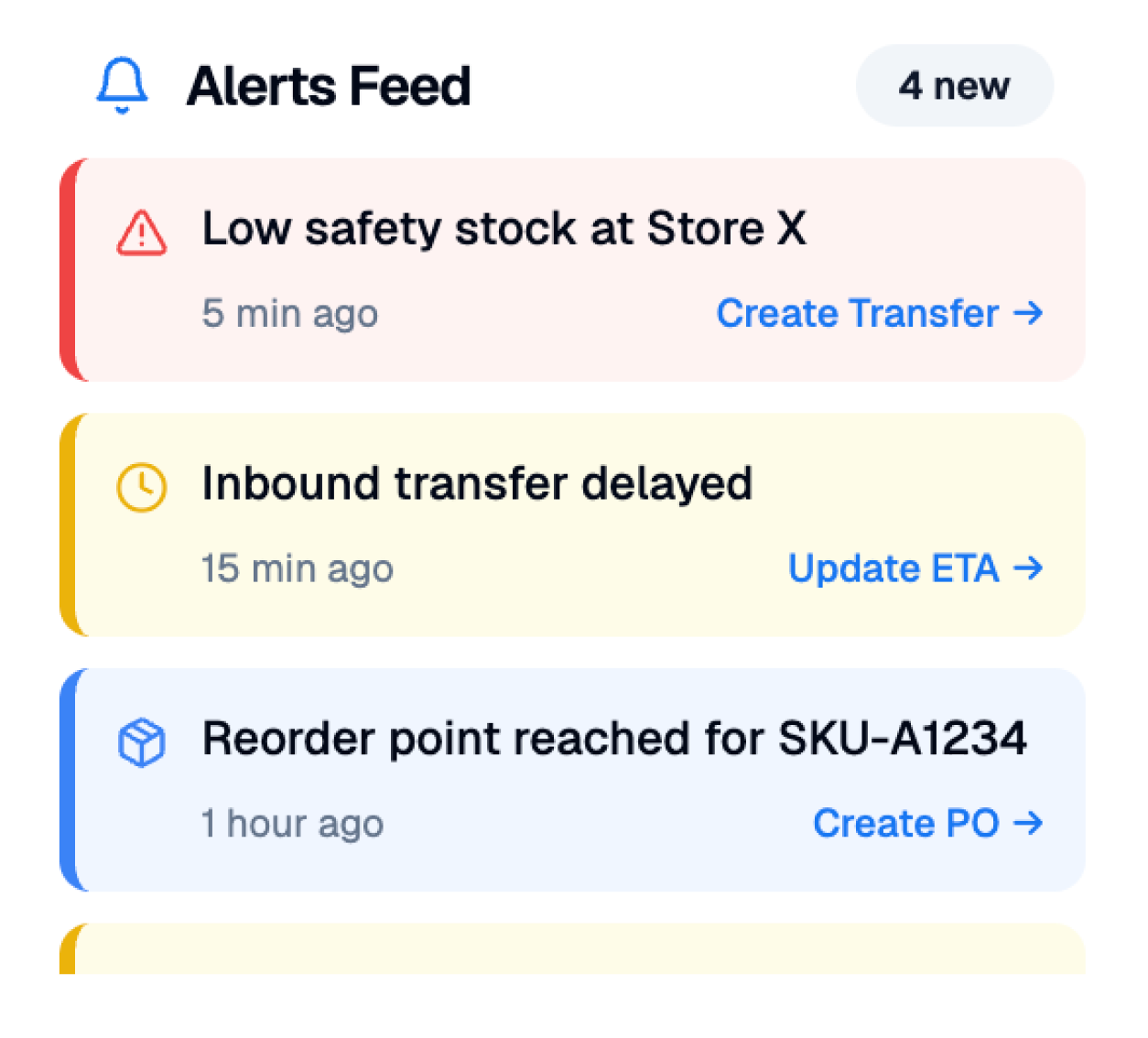
Even with automation, exceptions happen. High-performing systems monitor live conditions and raise alerts when parameters stop matching real-world behaviour.
Common triggers include:
Sudden increases in sales outpace the current Min–Max range.
Alert: “Demand exceeded expected velocity—review Min level.”
Inbound shipments repeatedly miss planned receipt dates.
Alert: “Lead time deviation increasing—adjust lead time buffer.”
Inventory is physically present but unavailable for sale.
Alert: “Available stock below Min due to freeze—replenishment at risk.”
System detects that Max cannot cover the review cycle or Min is too close to daily consumption.
Alert: “Parameter mismatch—recalculate Min–Max for SKU.”
Replenishment parameters only work when they evolve with the business. Lead times shift, demand patterns change, vendors fluctuate, and SKU behaviour moves through phases. If parameters stay static, the system starts operating on outdated assumptions—resulting in stockouts, excess stock, and erratic reordering.
High-performing brands treat parameter setting as a continuous process: weekly for critical SKUs, monthly for the rest, with overrides whenever real-world conditions change. When lead time, EOQ, and Min–Max are maintained as living inputs, replenishment becomes stable, predictable, and far less dependent on firefighting.
Avoid Stockouts surplus with —
Real-Time alerts & smarter forecasts.





.png)

